
Henry ‘Hank’ Larson was an early 20th Century IWW in Bellingham. Probably his main claim to fame was as a defendant in the 1919 criminal syndicalism trial in Bellingham (see the story of the trial here). He was known to some as the ‘old war horse’- he sure lived the life of a radical troublemaker, in a real good sense. Here is an early reference in Industrial Worker (one of the union’s several newspapers at the time) to FW Hank’s efforts to get subscriptions in 1910. The headline is almost surely the editor’s, not Hank’s.

‘Slaves’ is the Wob slang term ‘wage slave’ for a wage worker- dependent on a boss for income. A couple months later we see another credit to Hank’s efforts to get subscriptions, this time with a bit of biography by the editor:

EARLY LIFE- CHICAGO POLITICS
Who was Henry Larson? He was born in 1852 and grew up in Chicago. The ‘side fighter’ reference above is significant- though no documentation is known yet, he must have had something to do with the Haymarket 8-hour-day demonstrations in 1886. At some point he studied law under Clarence Darrow, the ‘attorney for the damned’- more than once in later years in Bellingham, FW Larson acted as a lawyer. We know that by 1896 he was active in the Peoples (aka Populist) Party in Chicago, which among other things had these Wobbly-ish planks in its platform:

First.—That the union of the labor forces of the United States this day consummated shall be permanent and perpetual; may its spirit enter into all hearts for the salvation of the Republic and the uplifting of mankind.
Second.—Wealth belongs to him who creates it, and every dollar taken from industry without an equivalent is robbery. “If any will not work, neither shall he eat.” The interests of rural and civic labor are the same; their enemies are identical.
ON TO BELLINGHAM
The Populist Party collapsed by the end of the 1890s. By 1905 Henry and his wife Emma were in Bellingham- why they moved is so far not known- likely for economic reasons. They lived in many places in town, but in 1906 they lived at 2430 Kulshan Street. He was a lather by trade. (Lathers build the wooden frame in a house on which plaster walls are laid). He later became a painter- not like Van Gogh, but a house painter. In 1905 he was elected secretary-treasurer of a new AFL Federal Union in town.

SOCIALIST PARTY
At some point he joined the Socialist party, founded in 1901 and something of a force in Bellingham in those days. He ran for numerous public offices on the Socialist ticket- Whatcom County prosecuting attorney in 1906, Bellingham mayor in 1909 ( he was disqualified from that ballot for not paying the required candidate fee, so ran for city council instead).

Well, he didn’t get elected. In fact, by 1910 the Socialist Party in Bellingham had split into two factions- the social democratic or right-wing ‘Yellows’, who were only a little to the left of progressive Democrats or Republicans and who did not out-right oppose capitalism, and the ‘Reds’, who were agrarian radicals, purist Marxists, and the hard-core labor radicals either involved in or supportive of the Industrial Workers of the World and a policy of direct action against capitalism. Henry was an outspoken ‘Red’- more on that coming.
LOCAL IWW SECRETARY
By then Henry had joined the IWW, organized in Chicago in 1905. An IWW ‘Mixed Union’ local was chartered here in 1906- this was like today’s General Membership Branches, consisting of workers in all industries, when there weren’t enough members in any given industry to charter an Industrial Union local. He was the Secretary of the first IWW Industrial Union in Bellingham, Local 337, chartered on November 30, 1909, and in the next year was recognized as the ‘Old War Horse’ as we saw above.


SOCIALIST PARTY FACTIONALISM
By 1913, factional fighting between Socialist party Reds and Yellows progressed to a virtual split in the local party. The Yellows were predominant, and Reds, including FW Larson, were expelled. These two clippings are from the November 24, 1913 Bellingham Herald:

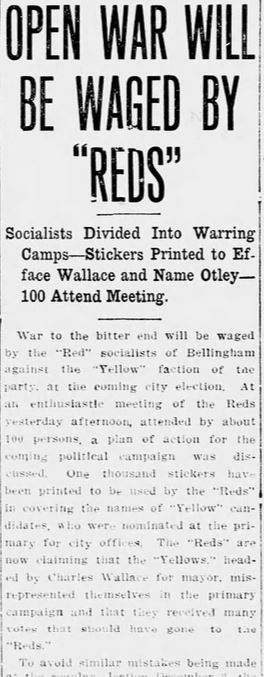

Whether Henry was readmitted to the party is not known. Likely not, as within a couple years he presided over the founding meeting of the new (and short-lived) Citizen’s Party.

ARREST FOR CRIMINAL SYNDICALISM, 1919
Henry Larson continued his membership in the IWW Local. It all came to a head on November 20, 1919, when he was arrested in his home by Bellingham’s finest and charged with criminal syndicalism. This was a new state law that made it illegal to belong to any organization that advocated any extra-constitutional change in the American political system, such as a general strike. The law was very specifically aimed at the growing power and influence of the IWW. The trial of Henry Larson and his 2 co-defendants- Local 337 Secretary Lafayette Ady and Jim Wilson, is discussed elsewhere on this website. Henry tried to represent himself in court, but the judge would not allow it, requiring him to be defended by the court-appointed defense attorneys, who were not supporters of the IWW. The defense opted to present no testimony or evidence, and after 10 days, the jury acquitted all of the Wobblies after a mere 4 hours of deliberation.

A few months after this trial, Henry was the lawyer for Fellow Worker Ady in another court case.
There is little documentation of Henry Larson’s life after that. He died on New Year’s eve, 1934. The Herald apparently forgot his earlier notoriety.

Henry Larson, ‘The Old War Horse’ Wobbly, is buried at Wildwood Cemetery in Ferndale. His grave is marked by a simple metal tag, a few inches across, on a 1-foot cement base. Ironically, his birthday is incorrect. His death certificate says he was born in 1852, and this jibes with his statement that he was ‘past 57’ in 1910. His wife Emma died in 1945 and lies beside him with an even simpler concrete marker. It just says “Emma Larson”. We need to remember and honor those fighters who went before us, who fought the good fight, for we all stand on their shoulders.


Wonderful job finding information on this this man, here was a consistent fighter for the working class!
JW- we are looking into more of these old-time Wobs in the area. Information is spa=se- these were mostly just ordinary working folks who didn’t get mentioned in the histories. Most of our records are from arrests, of which there were many for a variety of reasons; clearly some if not most were intended to harass. But stay tuned. IWW members here have located a number of graves of Fellow Workers, mostly unmarked, and we are discussing whether to publicize those or not. IWW